
When a New Filling Line Never Reaches the Performance It Was Bought For
How an independent engineering assessment helped separate machine capability from commissioning, reliability and integration issues on a trigger filling and capping line.
Industry: Household and hygiene products manufacturing
Line Type: Trigger filling and capping line
Expected Output: Contracted output significantly above current site performance
Observed Output Before Assessment: Well below target and highly inconsistent
Assessment Type: Independent engineering line assessment
Executive Summary
Packserve was asked to carry out an independent engineering assessment of a recently installed trigger filling and capping line which had failed to achieve the production performance expected at the point of purchase.
The line had been installed only a few months earlier, but performance remained significantly below target and highly inconsistent. Considerable engineering effort had already been invested by both the equipment supplier and the site team. Multiple faults had been reported across the trigger handling, filling and capping process, and there was no clear agreement on whether the main issue sat with machine design, component quality, commissioning, or a wider set of interacting reliability problems.
Packserve’s role was not to allocate blame for the history of the project. It was to provide an independent engineering view of the line’s current condition, identify the main technical constraints affecting performance, and establish whether the machine itself appeared fundamentally incapable of delivering the required output.
The assessment concluded that the remaining performance gap did not appear to be driven by one isolated fault or by an obvious fundamental design limitation within the machine. Instead, performance was being constrained by a small number of interacting technical issues within the trigger handling and dip tube insertion process, alongside the legacy effects of a difficult commissioning period and a line that still depended heavily on manual intervention to keep running.
Assessment Summary
Before the assessment
- A newly installed trigger filling and capping line was performing far below the expected output level.
- Best site performance remained materially below target, with output varying significantly from shift to shift.
- The site had already experienced repeated faults involving trigger orientation, dip tube insertion, crab claw assemblies, capper behaviour and pneumatic cylinder failures.
- Significant engineering time had already been spent by both the supplier and the site team, but the machine still required frequent manual intervention to maintain production.
- There was no clear view of whether the core issue was dip tube quality, machine design, component reliability, or a wider integration and commissioning problem.
After the assessment
- The principal technical constraints were narrowed down to a defined group of mechanisms within the trigger handling and insertion process.
- Packserve identified dip tube insertion performance, trigger head reliability and crab claw assembly behaviour as the highest-priority areas for structured investigation.
- The site gained an independent view that the machine did not appear fundamentally incapable of achieving its intended performance.
- The next phase of work became clearer: focused engineering investigation, controlled testing and validation of key mechanisms rather than broad reactive intervention across the whole machine.
The Challenge
The site had recently installed a new trigger filling and capping line intended to improve production performance. Instead, the line had entered operation with persistent faults, inconsistent output and a growing list of component failures and interventions.
The scale of the performance gap was significant. The line had been purchased against a materially higher output expectation than it was achieving in practice, yet typical site performance remained well below that level. The bigger problem was not simply low throughput in isolation, but the fact that the line had never settled into predictable operation since installation.
By the time Packserve was asked to visit, the site had already replaced large numbers of cylinders and crab claw components, dealt with repeated trigger sorting and capping issues, and spent considerable time trying to stabilise the machine. The equipment supplier’s position appeared to place significant emphasis on dip tube quality and straightness. That may have been one contributor, but it did not fully explain the range of faults, the inconsistency of performance or the scale of manual intervention still required to keep the line running.
The challenge was therefore not simply to identify another fault. It was to step back, review the machine as a complete system, and establish where the real constraints now sat.
The Assessment
Packserve attended site to carry out an independent engineering review of the machine in operation, supported by discussion with the site engineering team and review of the machine’s recent history.
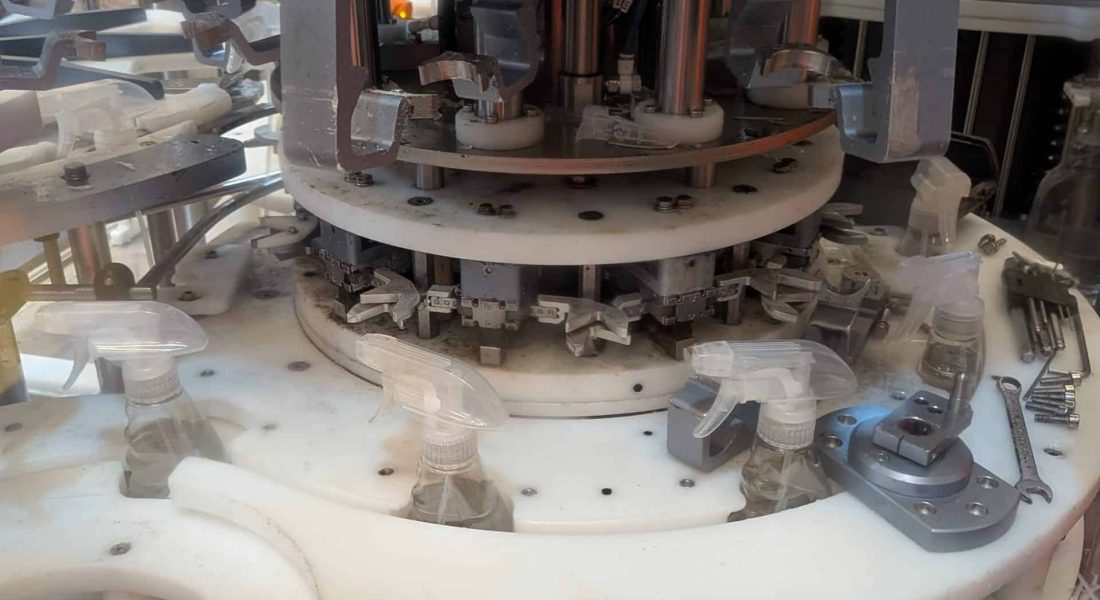
The purpose of the visit was to understand how the line was behaving as a complete system rather than focus immediately on one visible symptom. The assessment looked at:
- trigger feed orientation and presentation
- the trigger feed transition into the starwheel
- dip tube insertion behaviour and reject generation
- crab claw assembly design, condition and release behaviour
- pneumatic cylinder reliability within the gripper assemblies
- trigger head fault behaviour and reject generation
- the level of manual intervention required to sustain production
- the wider pattern of engineering modifications and commissioning legacy issues across the line
This mattered because by the time a line has been unstable for several months, visible faults are often only part of the story. The machine itself may have improved from its original condition, but the remaining performance gap can still be driven by a combination of component reliability, geometry, adjustment history, modifications, operator intervention and incomplete resolution of earlier faults.

What The Assessment Revealed
The machine did not appear fundamentally incapable of achieving the intended output
One of the most important findings from the visit was what wasn’t found.
Packserve did not observe any obvious mechanical or functional limitation that would prevent the machine from achieving its intended performance once the identified issues were resolved. In other words, the assessment did not support the idea that the line was inherently incapable by design.
That distinction mattered commercially. If the machine had been fundamentally incapable, the site would have been dealing with a very different decision: whether the original equipment concept itself was flawed. The evidence seen during the assessment pointed in a different direction. The line had improved significantly from its earlier reported condition and was producing saleable product, but a small number of unresolved technical issues were still constraining performance.
The real constraint sat within the trigger handling and dip tube insertion system
The assessment pointed to one part of the machine as the dominant source of ongoing inefficiency: the trigger handling and insertion process.
The main issues were not spread evenly across the whole line. They clustered around a specific group of mechanisms:
- trigger orientation and feed presentation
- dip tube insertion failures
- crab claw release behaviour and assembly variation
- pneumatic cylinder reliability within the claw mechanism
- trigger head damage and reject generation
This was important because it changed the engineering focus. The remaining work was not about making broad adjustments across the machine or continuing to chase isolated symptoms wherever they appeared. It was about stabilising a defined group of mechanisms whose behaviour was driving rejects, stoppages and operator intervention.
Dip tube insertion could not be explained by dip tube quality alone
Dip tube insertion failures remained one of the biggest contributors to current inefficiency. Failed insertions were generating rejected product and additional manual intervention.
The supplier view had largely focused on dip tube quality and straightness. Packserve’s assessment did not dismiss that as a factor, but it did conclude that it was too narrow an explanation on its own.
Observations during the visit suggested that additional factors could also be contributing to insertion failures, including:
- dip tube presentation into the insertion point
- crab claw release timing and geometry
- pneumatic cylinder behaviour
- trigger positioning consistency
That mattered because it prevented the site from collapsing a multi-variable problem into a single convenient explanation. If dip tube insertion performance had been attributed solely to consumable quality, there was a risk that other underlying mechanical and timing issues would remain unresolved.
The crab claw assemblies needed to be treated as a technical variable, not a fixed assumption
During inspection of the dip tube gripper assemblies, Packserve observed that not all crab claw assemblies were the same.
Some appeared to have been modified through the addition of guide components that were not present on other units. Those modifications may have been entirely justified, but they introduced another variable into a mechanism that was already central to line performance. The question was no longer simply whether the claw worked or not. It was whether different versions of the claw were changing how dip tubes were presented, retained or released.
That is exactly the sort of issue that can sit unnoticed inside a difficult commissioning project. A line accumulates changes, adjustments and fixes over time. Some improve performance. Some create new variables. Unless those changes are brought back under structured engineering control, the machine gradually becomes harder to diagnose because the baseline itself is no longer clear.
Packserve’s recommendation was therefore to compare modified and unmodified assemblies in a controlled way and validate whether those changes were influencing dip tube behaviour.
Cylinder failures needed root cause, not just more replacement parts
The line had already seen multiple cylinder failures, and a change in lubrication approach was being considered in response.
Packserve’s view was that this was not the point to jump straight to a lubrication solution. The cylinder type in use was designed to operate on clean, dry compressed air and did not inherently require continuous airline lubrication. On the information available during the visit, there was not enough evidence to conclude that lack of lubrication was the real cause of failure.
Other explanations remained entirely plausible:
- mechanical misalignment
- side loading through the claw mechanism
- contamination
- premature wear caused by how the assembly was operating under load
Again, the pattern is important. When a line is unstable, it is easy for repeated component replacement to become a substitute for diagnosis. Parts fail, parts get changed, the line runs again for a while, and the underlying cause remains in service. Packserve’s recommendation was to isolate the cylinder behaviour from the wider mechanism and understand the loading and alignment conditions properly before introducing a change that might mask the real issue.
Manual intervention was keeping production going, but also hiding the true scale of the problem
The line was capable of producing saleable product during the visit, but it still depended heavily on manual intervention.
Operators were removing rejected bottles, correcting trigger-related issues and helping the line through recurring faults before product moved downstream. That allowed production to continue, but it also meant the machine’s true performance condition was partly obscured by human effort.
This is a common pattern on underperforming lines. The machine does not fully stop, so the site remains in production, but a growing share of output is being protected by operator correction, engineering presence and workarounds. The line appears to be running, but it is no longer running cleanly or predictably on its own terms.
For the site, this was a key distinction. The issue was not simply whether the line could produce saleable product at all. It was whether it could do so repeatedly, at the required output level, without depending on constant intervention.
What Happened Next
The assessment did not attempt to solve every historical issue in one step. Instead, it created a structured engineering priority list focused on the areas most likely to unlock further performance improvement.
The recommended priorities were:
- Dip tube insertion performance
Carry out controlled observation of successful and failed insertions, comparing claw behaviour, dip tube presentation, cylinder movement and trigger consistency.
- Crab claw assembly validation
Compare modified and unmodified assemblies to establish whether assembly differences were influencing retention, release or alignment.
- Trigger head reliability
Complete fault investigation and validate corrective action to remove a known source of trigger damage and reject generation.
- Pneumatic cylinder assessment
Assess cylinder movement, alignment, side loading, wear and contamination before introducing any lubrication changes.
- Trigger feed orientation
Validate the proposed feed improvements to reduce incorrectly orientated triggers entering the machine.
- Maintenance and operating discipline
Strengthen inspection, cleaning and fault escalation routines around the line to support longer-term reliability.
The value of the assessment was therefore not that it “fixed the line” in a single visit. It was that it converted a difficult, noisy commissioning problem into a structured engineering worklist based on mechanism behaviour, evidence and technical priority.
Outcome
The most valuable outcome of the assessment was clarity around where the real performance risk sat.
Rather than treating the line as a generalised commissioning failure or continuing to chase symptoms across the machine, the site had a clearer view of the specific mechanisms now constraining performance and a more grounded basis for deciding what to investigate next.
Just as importantly, the site gained an independent engineering view that the line’s problems did not appear to be driven by one simple consumable-quality issue or by an obvious fundamental machine design limitation. The evidence pointed instead towards a set of technically solvable issues within trigger handling, insertion and reliability that required structured validation rather than more broad reactive intervention.
That changed the nature of the problem. It moved the site away from a generalised commissioning concern towards a narrower and more useful question:
Which specific mechanisms still need to be stabilised and validated before the machine can deliver the performance it was bought for?
Final Thought
New line problems are often discussed as if the main question is whether the machine itself is good or bad.
In reality, the more useful engineering question is narrower than that:
Is the machine fundamentally incapable of the required performance, or is it being held back by a small number of unresolved technical constraints, commissioning legacy issues and workarounds that have never been properly brought under control?
That was the value of this assessment. It gave the site a clearer engineering picture of where the problem really sat, what was still limiting performance, and where the next effort should be focused.