
The Line Didn't Have a Machine Problem. It Had a Stability Problem
How a structured reliability assessment helped identify the difference between symptoms, constraints and root causes on a PET bottling line.
Site Overview
Industry: Beverage Manufacturing
Line Type: PET Bottling
Target Output: 38 pallets per shift
Typical Output Before Assessment: 10–20 pallets per shift
Assessment Type: Packaging Line Reliability Assessment
Executive Summary
A beverage manufacturer operating a PET bottling line was struggling to achieve consistent production performance. Output ranged from as low as three pallets per shift to around 20 pallets against a target of 38.
The blow moulder was widely regarded as the primary constraint, but there was no clear understanding of whether performance was being limited by equipment condition, maintenance practices, operational behaviour or a combination of all three.
Packserve’s assessment concluded that the line did not have a single machine problem. It had a stability problem. Rather than pursuing isolated repairs, the site adopted a structured reliability programme focused on restoring stability, reducing operational uncertainty and creating a foundation for future performance improvement.
Assessment Summary
Before the assessment
- Blow moulder considered primary constraint
- Line performance highly variable
- Repeated operator intervention
- No clear understanding of root causes
After the assessment
- Multiple interacting causes identified
- Reliability programme established
- Critical spares strategy developed
- Clear improvement roadmap created
The Challenge
By the time Packserve became involved, the operation had been living with instability for some time. The site was experiencing highly variable output, frequent interruptions and growing uncertainty around what was actually limiting performance.
Running on four cavities instead of six had become normal.
Operator intervention had become normal.
Recurring faults had become normal.
The line was still producing, but increasing effort was being required to achieve increasingly unpredictable results.
The Assessment
The starting point was a simple question:
Does the line have a single constraint, or does it have a stability problem?
The initial review was carried out under live production conditions.
Machines were observed during normal operation, fault events and restart sequences. Equipment condition was assessed. Maintenance activities were reviewed. Operators and engineers were interviewed. Production behaviour was observed rather than simply discussed.
What quickly became apparent was that the line did not have a stable primary constraint.
Different machines appeared to become the problem at different times.
A short stoppage on one machine could escalate into disruption across the entire line.
Recovery after faults was often taking longer than the fault itself.
Operators were regularly intervening to compensate for issues elsewhere in the system.
Key Observation
The line was not behaving like a coordinated production system.
It was behaving like a collection of machines being held together by experience, workarounds and intervention.
That distinction became important because it changed the objective of the programme.
The goal was no longer to find a machine to blame.
The objective of the programme was not to make the line run faster. It was to make the line behave more predictably.
What The Assessment Revealed
Equipment Condition
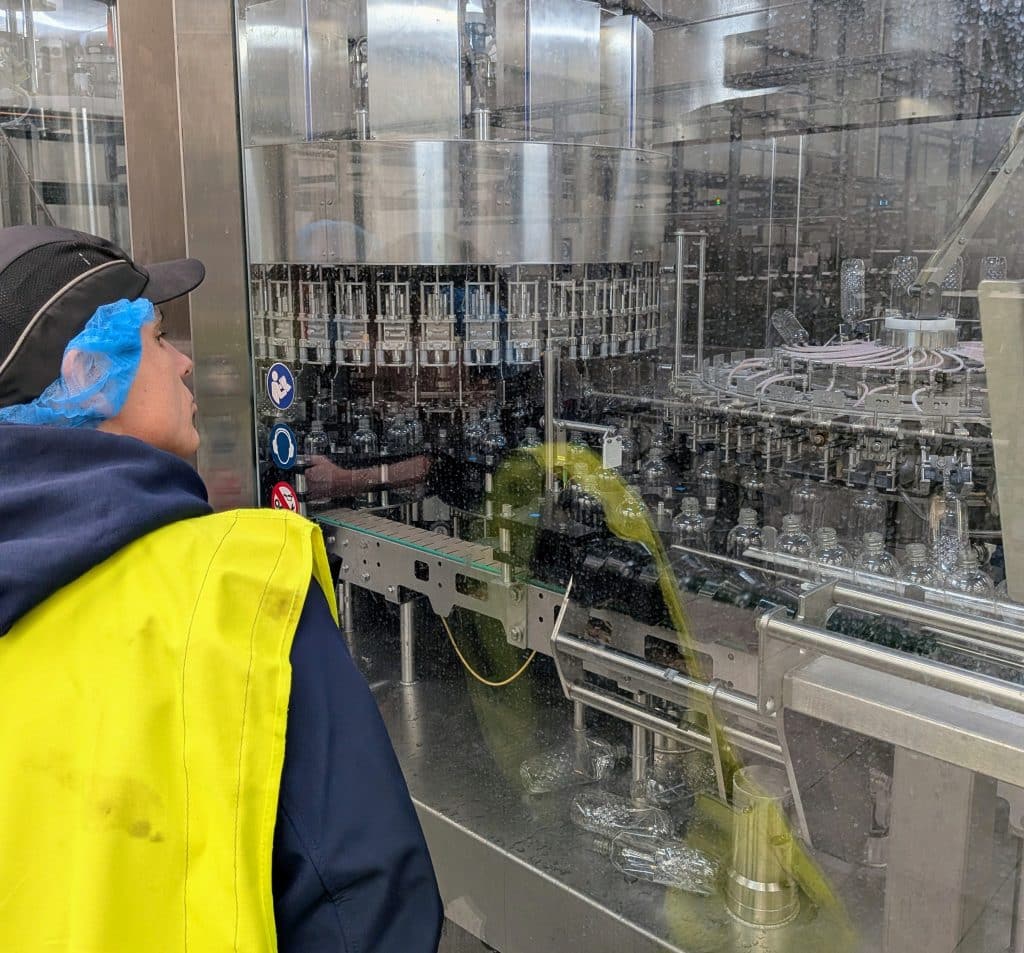
The blower was the most obvious source of instability and became the priority for detailed investigation.
Importantly, this wasn’t because it was assumed to be the only problem.
It was because it was the largest known source of variation on the line.
Until the blower condition was understood, it was impossible to understand what other constraints might be hiding behind it.
Strip-down and inspection identified valve block wear, stretch rod damage, bearing failures, lubrication issues, loose mould assemblies and other defects consistent with equipment that had accumulated a significant maintenance backlog.
Some issues were known.
Others only became visible once the machine was dismantled and returned to service.
This reinforced one of the key realities of reliability work.
Machine condition is often worse or better than expected. Until the equipment is inspected properly, nobody really knows.
As blower reliability improved, something interesting happened.
Problems that had previously been overshadowed by blower instability started to become more visible elsewhere on the line.
That was not a setback.
It was evidence that the assessment was beginning to reveal how the system actually behaved.
The objective was not simply to restore blower performance. It was to remove the largest known source of instability so that the behaviour of the wider line could be understood with greater confidence.
Maintenance Standards
The site was not lacking maintenance effort.
- People were working hard
- Maintenance schedules existed
- Inspections were being completed
- Information was being recorded
The issue was that recurring conditions were not always being translated into permanent corrective action, which meant some sources of instability remained in service for longer than they should have done. Over time, the operation had adapted to managing variability rather than systematically removing it.
Examples included missing machine components not being escalated, known defects remaining unresolved and inspection findings not consistently resulting in corrective actions.
Process Control
One example captured the wider theme of the programme particularly well.
The packer was experiencing repeated instability. Instead of receiving the expected bottle flow, bottles were arriving inconsistently, falling over and disrupting pack formation.
The immediate assumption was that the packer was at fault. Attention then shifted towards conveyor speeds and line balancing. Neither explanation proved correct.
Further investigation identified excessive CO₂ dosing that had been introduced following an adjustment made on the line.
The increased pressure was affecting bottle behaviour upstream. The effect only became visible once the bottles reached the packer.
The packer was not causing the problem. It was simply the first machine that could no longer absorb it.
This became a useful reminder that the point where a problem appears is not always the point where it starts.
Standards, Knowledge and Decision Making
As on many production sites, a significant amount of practical knowledge sat with a relatively small number of experienced individuals. This meant line behaviour and fault recovery could vary depending on who was on shift and how problems were approached. Long-term reliability requires that knowledge to be supported by standards, procedures and training, not held only in experience.
What Happened Next?
One of the most important outcomes of the assessment was that the site now had a clear sequence for improvement.
Before the review, engineering effort was often directed towards whichever problem happened to be causing the most disruption at the time.
After the review, there was a clearer understanding of which issues were driving instability and which actions would have the greatest impact on improving control.
The assessment resulted in a structured reliability programme focused on three priorities:
- Restore Blower Stability
The blower remained the largest known source of instability on the line.
The objective was not simply to repair individual defects, but to establish a stable mechanical baseline and understand the true condition of the machine.
Only once that baseline existed could the wider behaviour of the line be assessed with confidence.
- Establish Critical Spare Part Coverage
The review identified a number of reliability-critical components that were either unavailable or held in insufficient quantities.
A structured spare parts strategy was developed to reduce operational risk, improve recovery capability and avoid repeat exposure to known failure modes.
- Improve Maintenance and Operational Control
The assessment identified opportunities to improve maintenance visibility, fault escalation, engineering standards and operational consistency.
The objective was not to introduce more procedures.
It was to ensure that knowledge, maintenance activity and fault-finding methods became repeatable across shifts and individuals.
The programme therefore focused on creating more predictable outcomes rather than increasing activity.
Outcome
The most valuable outcome of the assessment was a clearer understanding of how equipment condition, maintenance practices, operator intervention and process behaviour were interacting to influence performance.
With production often operating at 10–20 pallets per shift against a target of 38, the priority was not finding more speed. It was understanding why available production time was not being converted into output.
Several issues previously believed to be root causes were shown to be symptoms.
Reliability risks could now be prioritised based on evidence rather than assumption.
Improvement activities were organised into a structured roadmap, providing a clear sequence for future engineering effort and investment.
At the site’s typical production rates, even relatively small improvements in stability had the potential to unlock significant additional output, reduce operational pressure and improve confidence in day-to-day planning.
Most importantly, the site moved from reacting to individual faults towards managing line reliability as a system.
That change in understanding created the foundation for future improvement.
Key Lessons for Engineering Managers
- The Most Visible Problem Is Not Always The Constraint
The machine receiving the most attention is not necessarily the machine limiting performance.
- Stability Must Come Before Performance
Improving output starts with establishing predictable behaviour.
A line that cannot recover consistently from routine disturbances will rarely achieve its theoretical capacity.
- Maintenance Backlogs Accumulate Quietly
Many reliability problems develop gradually and become accepted as normal operating conditions.
- Operator Intervention Can Hide Root Causes
Workarounds often keep production running but make fault diagnosis more difficult.
- Packaging Lines Behave As Systems
Equipment condition, maintenance, process control and operational behaviour all interact.
Understanding those interactions is often where the biggest opportunities for improvement are found.
Final Thought
Reliability problems rarely exist in isolation.
The most visible fault is not always the most important one, and the machine receiving the most attention is not always the machine limiting performance.
Establishing stability first creates the foundation for every improvement that follows.