
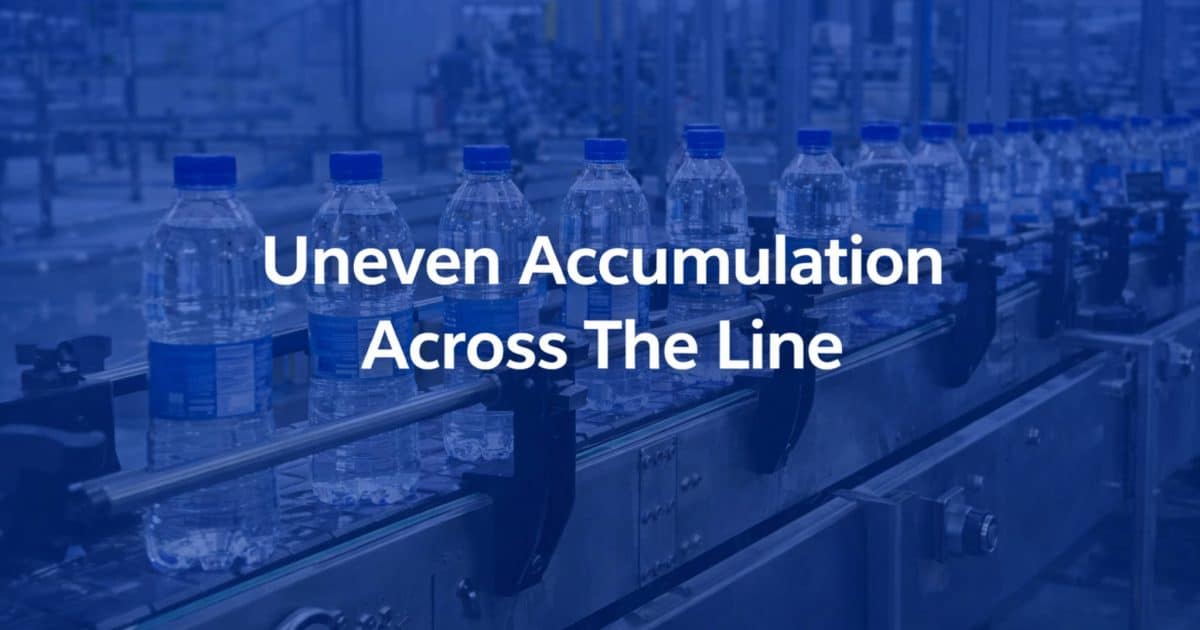
Uneven accumulation across a packaging line doesn’t always show in alarms or reports. You see it in how the line carries product. In one section, accumulation begins to hold. It doesn’t sit evenly; it builds in one area while the section ahead has already started to clear. The shape isn’t consistent. It never quite lines back up.
At a glance, everything still moves. But the system has lost its ability to dampen variation.
How The Accumulation Carries Out Of Step
The accumulation does not move forward as one consistent body. It holds in one section, then begins to clear further along, but not all at once. One part releases earlier. Another part lags behind. As it moves, the shape stretches and breaks apart.
At the same time, the carry across sections is being kept in motion. Small changes appear, then disappear. One section lightens slightly, another fills again. The overall level shifts, but never settles into one shape. The line continues to move product, but it is operating right at the edge of its stable operating window.
This creates a repeating pattern:
- Accumulation holds longer in one section.
- Clearing begins further along before the hold has matched it.
- Part of the line drops away while another part still carries.
- The imbalance moves forward but does not resolve.
- The next section repeats the same uneven carry and release.
The line continues to move product forward. But the level never lines back up.
Why It Doesn’t Stand Out At First
Uneven accumulation often sits inside normal running. Product continues to move, so the variation does not stand out immediately. One section holds, another clears, and because both are active, the difference in level can look temporary.
Because the accumulation is not levelled, the system has no ‘spare’ capacity to handle the next minor stop. It becomes a fragile process rather than a resilient one. As product keeps passing through, the same pattern returns. One area carries more than the next. The line appears to be running, but the accumulation never settles into one level.
From a distance, it can look controlled. Up close, it is constantly shifting.
- Accumulation remains uneven while product continues to move.
- Clearing further along masks the earlier hold.
- The level never fully evens out across sections.
- The same imbalance reappears as product passes through.
- Movement continues without returning to one consistent state.
The line keeps running. But it never returns to one level. Accumulation holds in one section, clears inconsistently further along, and continues through the line without ever settling into one even level.
About the Author
Jon works with manufacturing teams to analyse packaging line behaviour and identify reliability risks within complex production systems.
His work focuses on how planning decisions, system design, and equipment interaction influence overall line performance and long-term stability.