
A packaging line can start the shift looking steady. Product is moving cleanly, output is there, and nothing obvious suggests the line is close to becoming difficult to hold.
Then a small interruption happens. A short stop clears, the line restarts, and on paper everything appears to have returned. The machines are running again, product is moving again, and the issue looks finished.
But the line has not always come back in the same condition.
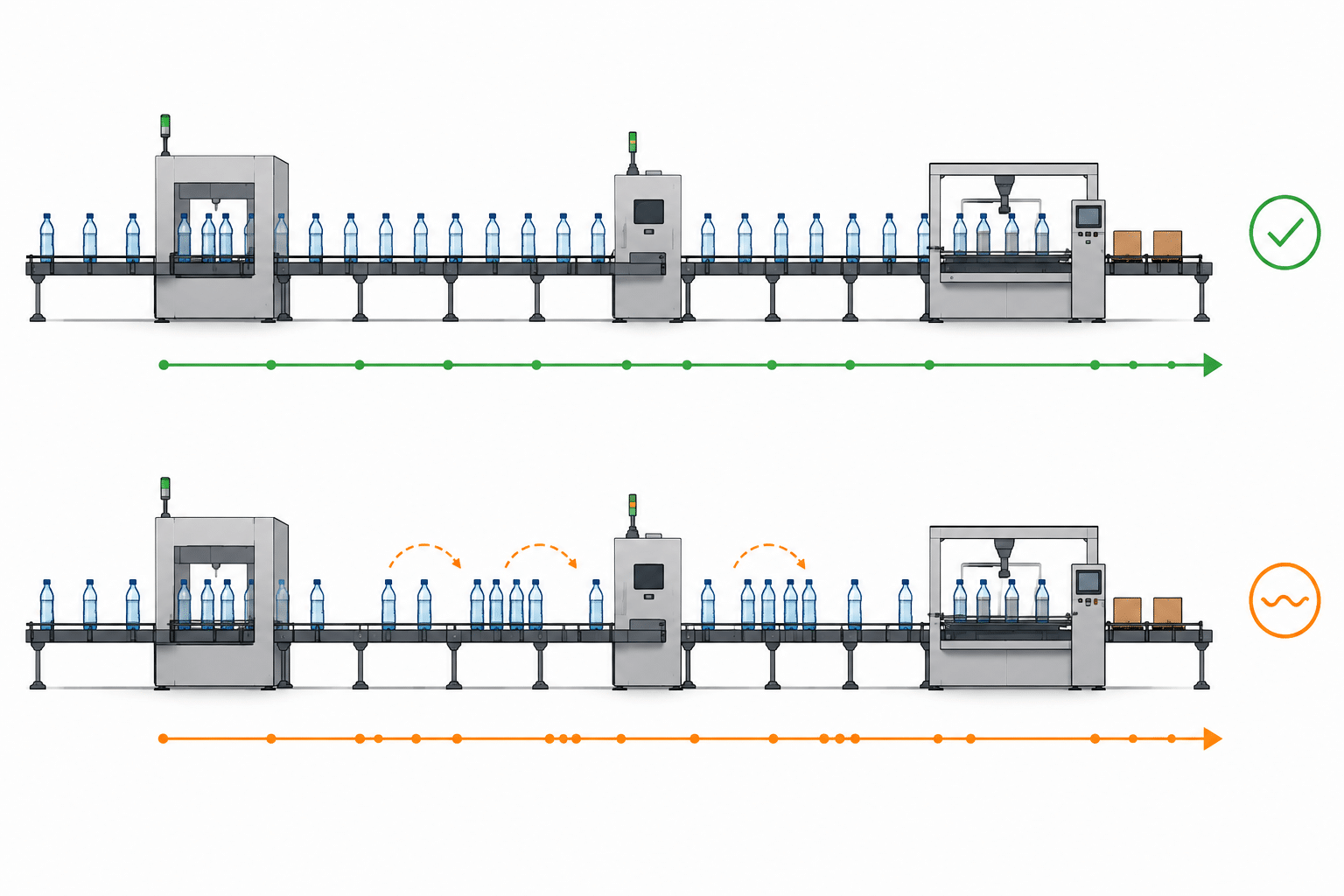
You often see it after a brief hesitation when bottles begin moving again but the spacing returns unevenly. Upstream keeps feeding product, downstream takes a little longer to pull clear, and the flow starts rebuilding in small groups rather than one steady pattern.
That is usually where the line starts drifting away from the rhythm it had earlier in the shift.
The change is rarely dramatic at first. Recovery takes slightly longer, gaps stop rebuilding evenly, and the next interruption arrives before the line has fully settled again. Each stop looks manageable on its own, but each recovery leaves something behind it.
The stop itself is usually not the difficult part. What matters is how the line comes back afterwards. If recovery does not settle properly again, the next interruption starts from a less stable position than the one before.
The line keeps moving, but movement is not the same as recovery.
Stable flow is not usually lost in one moment. It drifts as recovery leaves more variation behind than the line can naturally absorb.
About the Author
Jon works with manufacturing teams to understand how packaging lines behave under real operating conditions and where reliability is lost across the system.
His work focuses on how planning decisions, system design, and equipment interaction influence overall line performance and long-term stability.