
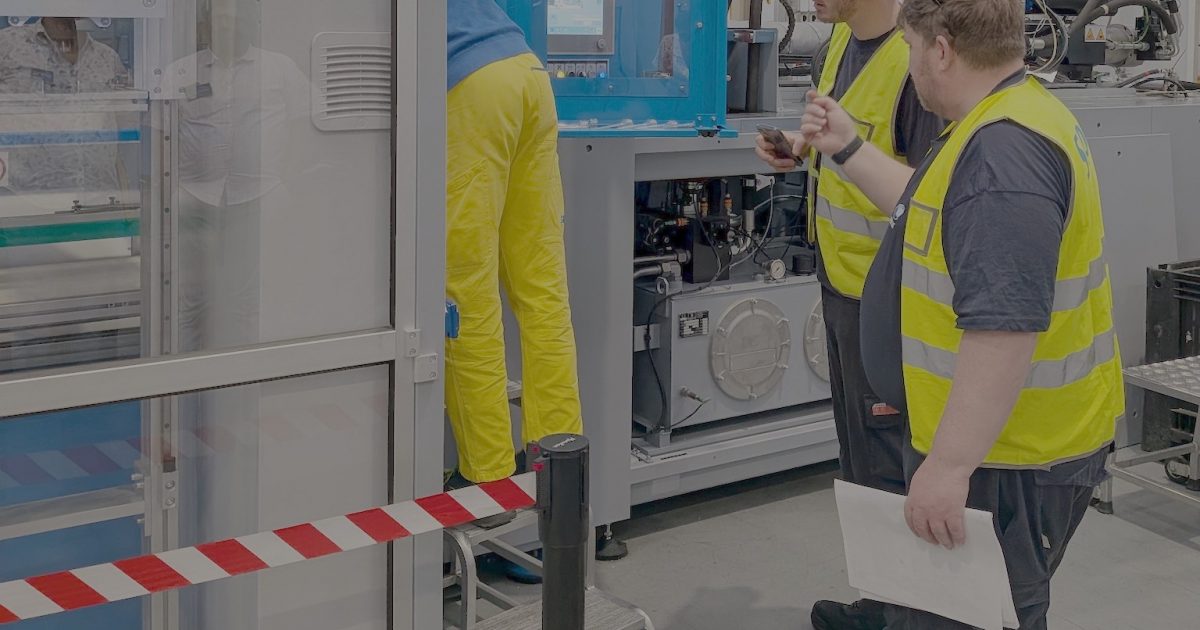

Buying a new bit of kit should be the easy part of the job.
You agree the specification, pick the supplier, sign off the order and watch it get built. Everyone assumes that once it is bolted down and powered up, the line will start moving in the right direction.
Sometimes it does. Quite often, it doesn’t work as smoothly as everyone expected.
Over the last year, I’ve spent time on a number of sites where relatively new machinery was struggling. Different products, different OEMs and different sectors, but the head-scratching on the factory floor was remarkably similar.
It’s rarely because the machine is fundamentally wrong.
More often, it’s because the project wasn’t anywhere near as finished as the paperwork suggested.
The machine is only one part of the line
A packaging machine doesn’t run in a vacuum.
It has to deal with whatever batch of bottles, cans or preforms that arrive that morning. It has to fit into the flow of the existing line, work with the operators on shift and be supported by the site engineers long after the OEM commissioning engineer has packed his bag and gone home.
It sounds obvious, but this is often where things start to go sideways.
I’ve walked onto sites where the machine arrived before the maintenance team had properly looked through the manual, never mind received meaningful training. Critical spares hadn’t been identified. Or the equipment had only ever run one ideal format during testing, rather than the more awkward products it was actually bought to handle.
None of that necessarily stops you squeezing a few pallets out on day one.
It just makes it far more likely that you’ll be pulling your hair out six weeks later.
Programme pressure can undermine good engineering
We all know what happens when deadlines get tight.
The installation is running behind. Production is under pressure to get volume through. The OEM is under pressure to ship, and nobody wants to be the one holding up the handover.
So the FAT gets squeezed down to a couple of hours, or only one product format is properly tested. The SAT effectively becomes the first live production run. Commissioning carries on while customer orders are already waiting.
At the time, each decision can feel completely justified. Everyone is trying to keep the project moving.
The problem is that once the switch is flicked to live production, you rarely get that quiet window back to bed the line in properly.
Then the line starts adapting
This is the part I see everywhere.
An operator finds a small adjustment that prevents a jam. An engineer tweaks a guide rail or moves a sensor slightly to get through the night shift. Someone turns a conveyor down by 5% because it worked the day before.
None of those changes is necessarily wrong.
In fact, they are often what stops the line from falling over completely.
But fast-forward a month and the machine is no longer running anywhere near its original baseline. It is running on a patchwork of adjustments introduced across different shifts to deal with different problems.
When I’m asked to look at one of these lines, one of my first questions is:
“What has actually been changed since installation?”
Quite often, nobody has the complete answer.
The changes have been made piecemeal, across several shifts and by several different people. What started as a five-minute temporary fix on a Tuesday night has quietly become the normal way of operating the machine.
The machine can only work with what it is being fed
The other common issue is variation in the packaging components themselves.
Machines are designed to operate within a particular tolerance window. If the bottle neck dimensions start to vary, carton board becomes softer, or closures arrive with slightly different tolerances, the machine has to work much harder to produce the same result.
I’ve seen engineers spend days adjusting capper heads, guides or timing screws when the machine was doing broadly what it had been set up to do. It was simply having to deal with inconsistent materials.
That doesn’t mean the machine has no part to play.
It means you need to understand the whole picture before reaching for the Allen keys or changing drive parameters.
Handover is more than making saleable product
I think commissioning is often misunderstood in our industry.
People see a good bottle coming off the end of the line and assume the job is finished, it isn’t.
For me, commissioning is only complete when there is a repeatable operating baseline. That means:
- operators know what a good setup looks like, and what a poor one looks like
- shift engineers know how to return the machine to a known position when things start to drift
- recipes, settings and mechanical positions are properly recorded
- the machine behaves broadly the same on a Monday morning as it does on a Thursday night
Once you have that, you have a proper reference point to work from.
Getting back to square one
It is much easier to optimise a machine with a clear baseline than it is to diagnose one that has gradually drifted over six months.
Without a known reference point, every fault-finding exercise involves more guesswork. Each new adjustment risks compensating for the previous one rather than dealing with the underlying issue.
Getting a line back to a stable baseline isn’t always quick.
But it gives the operators, engineers and management team a common understanding of what normal should look like.
Once you know where square one is, the next engineering decisions usually become much clearer.
Final thought
Most new packaging machinery doesn’t struggle because someone has simply bought the wrong machine.
More often, the specification was too narrow, testing was compressed, handover was incomplete, and sensible short-term workarounds gradually became the normal way of running.
That’s why the useful question is not always:
“What’s wrong with the machine?”
It is often:
“What has changed since it was installed, and do we still have a reliable baseline to work from?”
That is usually where the real investigation starts.
Related articles
The Line Didn’t Have a Machine Problem. It Had a Stability Problem.
When a New Filling Line Never Reaches the Performance It Was Bought to Deliver
About the author
Jon Puleston-Jones is Managing Director of Packserve. He works with manufacturers to understand packaging line reliability, identify the causes of unstable performance and bring engineering control back before further changes or investment are made.