
A production line can look capable of running faster than it does day to day. The rated speed may be achievable for short periods, and individual machines may appear to have enough capacity. But usable output is not defined by the fastest moment. It is defined by how steadily the line recovers during normal production.
You usually see it after a short stop near the labeller. The line restarts, bottles begin moving again, but the gaps return unevenly. A few arrive close together, a larger space opens behind them, and the downstream section takes longer to settle than the upstream section feeding into it.
At higher speed, small variations travel further through the line before they have time to clear. Changeovers interrupt recovery, upstream variation changes spacing, and each restart begins from a slightly different condition than the one before.
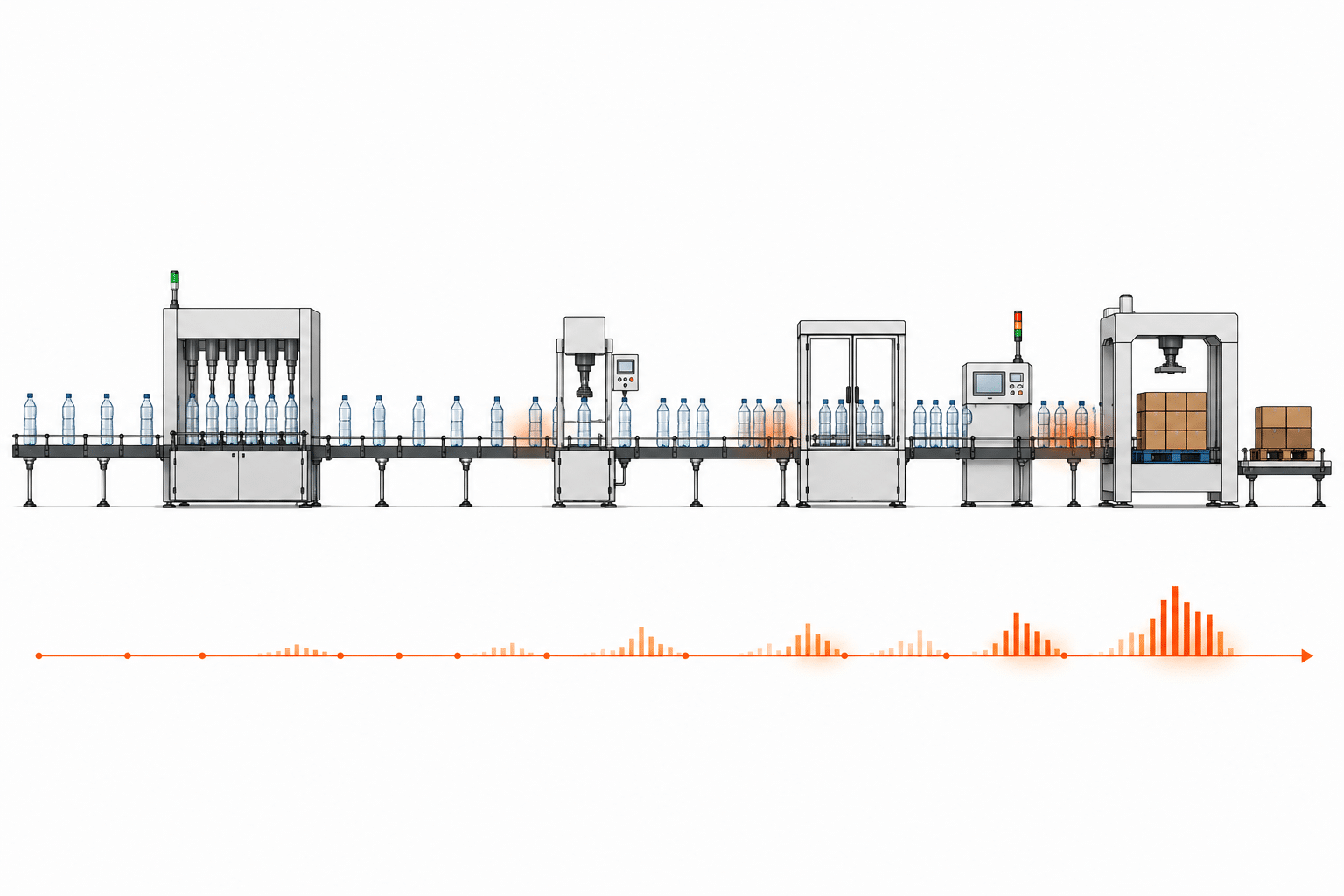
The line may still briefly reach target speed, but sustained output becomes harder to hold once recovery stops returning the flow to one repeatable rhythm.
This is why speed can become misleading. A line running harder is not always producing more. Sometimes it is simply carrying instability faster through the system.
Reducing speed can make the line appear calmer, but it may only be hiding the same recovery behaviour rather than resolving it.
The real question is rarely whether the line can run faster.
It is whether the system can return to one steady pattern after the disruptions that happen during normal production.
Once recovery stops returning the line to one repeatable rhythm, the flow often begins drifting further away from the stable condition it started with.
About the Author
Jon works with manufacturing teams to understand how packaging lines behave under real operating conditions and where reliability is lost across the system.
His work focuses on how planning decisions, system design, and equipment interaction influence overall line performance and long-term stability.